Are you ready to get rich with lots of Coins & Lives in your Royal Smash for free? Look now further, just use our working Royal Smash CHEAT TOOL GENERATOR!
What I appreciate about this system is its transparency. The game does not obfuscate the exchange rate or hide the costs behind layers of nested menus. You know exactly what a life costs, and you know exactly how many coins you have. There is a certain honesty to it. And the “double your coins” rewarded ad—the one that appears after certain levels and offers to multiply your earnings if you watch a thirty-second video—is one of the smarter monetization designs I have encountered in this genre. It respects your time enough to make the trade feel optional and genuinely beneficial, rather than punitive .
The interplay between lives and coins creates a fascinating psychological loop. When you have five lives and a healthy coin balance, you feel invincible. You experiment with wild angles, you try trick shots, you laugh when a cannonball ricochets off a steel plate and accidentally destroys a single jar instead of the tower you were aiming for. But when you are down to one life and your coin balance is hovering just below the cost of a refill, every shot becomes weighted with consequence. You find yourself tracing the trajectory line more carefully, zooming in on the structural weak points, calculating whether that support beam will actually collapse under the weight of the falling stones or whether it will stubbornly hold . The economy transforms the game from a casual time-waster into something that demands genuine attention, without ever crossing the line into outright stress.
There is a critique to be made here, and I would be dishonest if I did not acknowledge it. Some players find the lives system unnecessarily restrictive for a game that markets itself as a stress-relief experience. One reviewer on Google Play complained that even after making a purchase, the game still limits your attempts, which feels counterintuitive to the promise of casual, carefree destruction . It is a fair point. When the core loop is as satisfying as Royal Smash!—when watching a tower crumble in slow, physics-driven motion releases a tiny hit of dopamine that makes the rest of the world fade away—the artificial scarcity of lives can feel like a wet blanket thrown over a perfectly good fire.
But I think that critique misses something important about how the game is designed to be played. Royal Smash! is not a game you are meant to grind through in a single weekend. It is a game you return to in short bursts. Ten minutes on the couch while dinner simmers. Five minutes in the waiting room before an appointment. The lives system, irritating as it can occasionally be, enforces a rhythm that actually enhances the experience of each individual level. When you only have three shots left, you savor them .
The coins, meanwhile, provide a pressure valve. They give you agency. They let you decide when a level is worth pushing through and when it is better to walk away and come back later. That is a surprisingly mature design choice for a game about shooting a cannon at pottery.
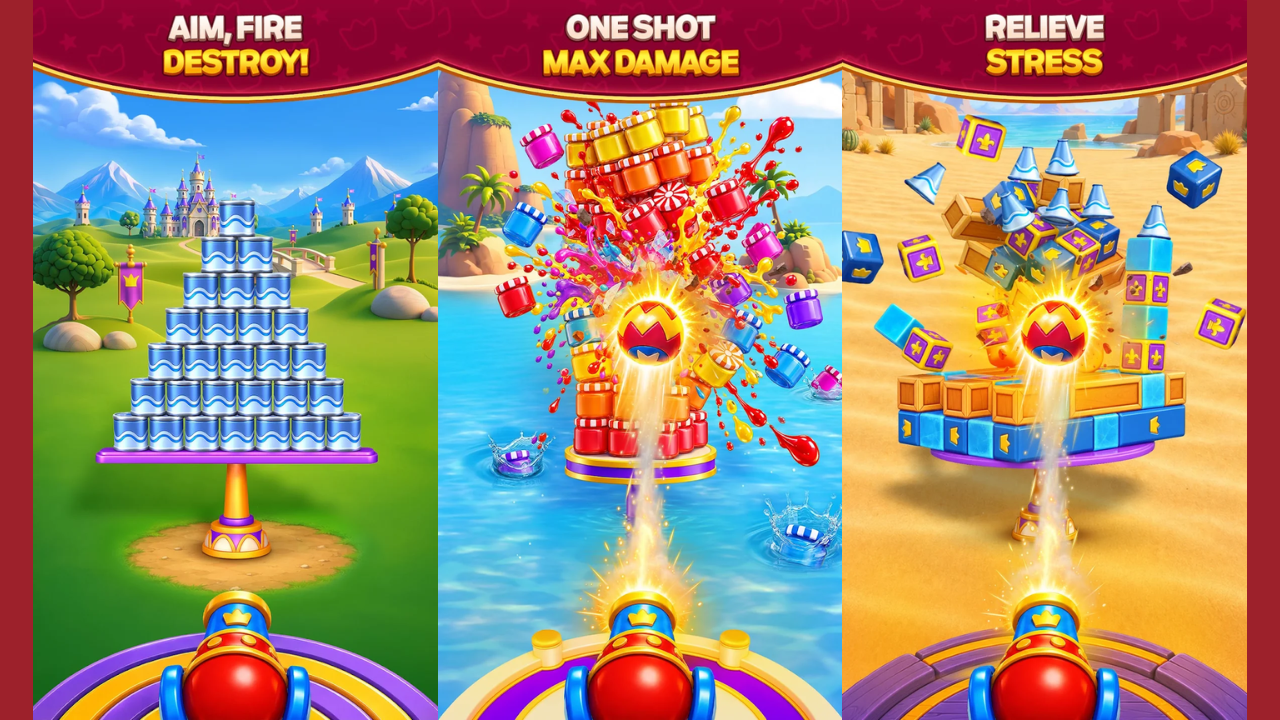
And the destruction itself—the reason any of us are here—remains the star of the show. The physics are genuinely impressive. Jars shatter with a satisfying crack. Stone blocks tumble and collide with believable weight. Towers that look sturdy sway ominously after a glancing blow, and then, with one more well-placed shot, they collapse in a cascade of debris that feels earned . The sound design deserves a special mention. There is a reason multiple reviews describe the destruction as “ASMR-like” . The crunch of breaking stone and the tinkle of shattering glass are calibrated to trigger something primal and pleasant in the back of your skull.
After a week of playing, I have come to think of Royal Smash! as a conversation between patience and impulse. The lives system asks you to be patient. The coins offer the temptation of impulse. The physics rewards you for thinking ahead, for identifying the load-bearing jar, for waiting that extra half-second to see if the tower will actually fall or if you need to fire again . It is a simple game, but it is not a stupid one.
Would I recommend it? Absolutely, with one caveat. Download it expecting a marathon, and you will hit the paywall and the life timer within an hour. Download it expecting a series of brief, satisfying, occasionally frustrating but always rewarding moments of destruction, and you will find yourself returning to it again and again. The coins and lives are not obstacles. They are the rhythm section. They keep the beat. And when the beat drops—when that tower finally crumbles and the level clears with a single shot remaining—you understand why the game made you wait.
The Crown Costs Extra: Living Off Coins and Lives in Royal Smash
I downloaded Royal Smash on a slow Sunday afternoon with the casual confidence of someone who has played every puzzle game ever made. Colourful tiles, a cheerful castle, a few explosions, nothing I couldn’t handle between sips of coffee. Forty minutes later, I was staring at a grey, lifeless heart icon and a countdown timer, wondering how a game this charming had managed to lock me out of the palace so quickly. That was my first real lesson in Royal Smash: the puzzles are only half the game. The other half is an economy of two humble resources, coins and lives, and learning to manage them is what separates the player who drifts happily through the kingdom from the one who ends up cursing at a timer on the bus.
Let’s start with lives, because they are the first thing the game teaches you to respect. Every attempt at a level costs you one, but only when you fail. Win, and your hearts stay intact. Lose, and one quietly drains away, the little icon dimming as if the kingdom itself were disappointed in you. When I started, the loss felt trivial, since I had a healthy stack of hearts and a head full of optimism. But lives have a way of disappearing in clusters, and the cruellest part of the design is that they vanish fastest exactly when you’re most invested, on a stubborn level you’re sure you can crack on the next try.
What makes lives such an effective piece of design is that they turn frustration into a pause rather than a wall. The game never says you cannot play. It says you cannot play right now. Hearts return on their own as time passes, one at a time, which means that walking away is always rewarded. I learned this the hard way after a sulky three-hour binge on a single level, during which I burned through every heart and gained nothing but a headache. When I came back the next morning, with a full row of hearts and a clearer head, I beat that same level on my second attempt. Lives, I realised, are less a punishment than a nudge toward patience.
There is, of course, a commercial logic beneath that gentle nudge, and it would be dishonest to pretend otherwise. Lives are the game’s most visible scarcity, and scarcity is what makes everything else on the shop screen look tempting. When your hearts are gone and a level has humiliated you three times in a row, the option to refill them instantly feels less like a purchase and more like a rescue. I noticed the game rarely pushes this too hard, which I appreciate, but the offer is always there, glowing quietly at the edge of the screen like a street vendor who knows you will eventually get hungry.
Coins are where the real strategy begins. If lives are the clock that limits how long you can play, coins are the currency that lets you bend that clock, and every player quickly discovers that coins can do far more than refill hearts. They buy extra moves when a level ends one swipe short of victory. They purchase boosters, those powerful one-off helpers that can clear a stubborn corner of the board. And yes, they restore lives when the timer feels unbearable. Three uses, one balance, and a constant, nagging question: where should this coin go? That question is the heart of Royal Smash’s meta-game, and it is far more interesting than it first appears.
My first mistake, and I suspect it is nearly everyone’s first mistake, was spending coins on extra moves the moment a level slipped away from me. There is a particular thrill to it. You’re two moves from victory, the board is a mess of half-finished combos, and a small button offers you five more chances for a handful of coins. I pressed it every time. I won a few levels that way and felt clever. Then I opened the shop one evening, saw my balance had dwindled to almost nothing, and realised I had been buying my way through problems I could have solved by simply thinking harder, or by replaying the level with a fresh heart.
A few weeks in, my relationship with the kingdom has settled into something comfortable. I log in each morning, collect what the game offers, play a handful of levels, and stop when my hearts run low rather than pushing through on coins. My balance grows slowly but reliably, and when a truly ruthless level arrives, I have the resources to meet it without regret. It is a small, satisfying sense of mastery, the kind you do not expect from a game about swapping coloured tiles, and it is the best thing Royal Smash has taught me.
So, are coins and lives the dull plumbing behind a bright puzzle game, or are they the real game hiding in plain sight? After weeks of hearts lost, coins spent and a few hard-won lessons, I lean firmly toward the latter. The matching is pleasant, but the managing is what keeps me thinking, planning and returning. Royal Smash hands you a crown, then quietly asks whether you can afford to wear it. For the most part, if you play patiently, spend wisely and respect the slow rhythm of the hearts, the answer turns out to be yes.